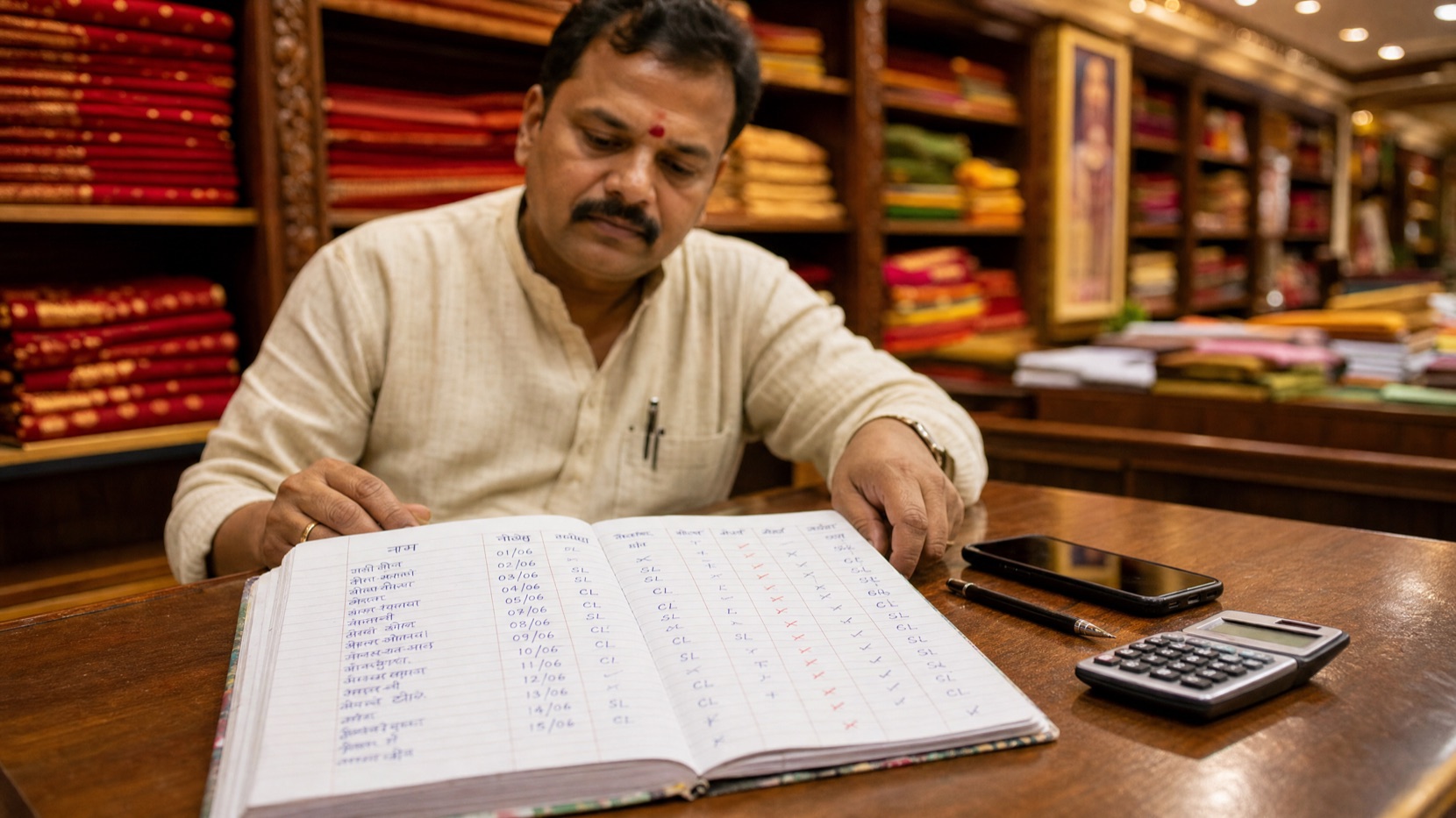

It was a Monday morning. Diwali rush was three weeks away. Rajan, who runs a saree showroom in Coimbatore with eleven staff, walked in to find his best salesman missing. No call. No message. Just an empty counter and a queue of customers already forming at the door.
By noon, the salesman showed up. "Sir, I had a family function. I took my casual leave."
Rajan had no idea how many casual leaves this employee had left. He had a diary somewhere. He thought he had used two already. Or was that last year?
Leave management for shop employees in India is rarely the problem people assume it is. This is not a rare story — it plays out in thousands of shops every single day. The trouble is never that the employee took leave; he is legally entitled to it. The trouble is that nobody was tracking it properly.
That, in one sentence, is the whole game: not generosity, but a clear running record of who is entitled to what, and what it costs you when someone runs over. Here is how the rules actually work — state by state — and why the diary keeps letting you down.
How many leaves are shop employees legally entitled to?
Here is the thing most shop owners do not know: leave entitlements for shop employees are not set by the central government. They are set by each state under its own Shops and Commercial Establishments Act. So what applies to your shop in Mumbai is different from what applies in Chennai or Delhi.
There are three types of leave that matter for most retail shops:
Casual Leave (CL) is for urgent, unplanned situations — a sick child, a family function, a personal emergency. It is typically 6 to 12 days a year depending on your state. It cannot usually be carried forward to the next year.
Sick Leave (SL) is specifically for illness or medical reasons. Most states require a doctor's certificate for sick leave beyond two or three consecutive days. It ranges from 7 to 15 days a year.
Earned Leave (EL) / Privilege Leave (PL) is leave that the employee earns by working. The most common formula is one day of earned leave for every 20 days worked. So an employee who works 240 days in a year earns 12 days of paid leave. This type of leave can usually be carried forward, up to a state-specified limit.
Here is how the rules look for the states where most of Rotabook's users are based:
| State | Sick Leave | Casual Leave | Earned / Privilege Leave | EL Carry-Forward Limit |
|---|---|---|---|---|
| Maharashtra | Nil | 8 days/year | 1 day per 20 days worked | Max 45 days |
| Tamil Nadu | 12 days/year | 12 days/year | 12 days/year | Max 24 days |
| Karnataka | 12 days/year | Nil | 1 day per 20 days worked | Max 30 days |
| Delhi | 12 days/year | 12 days/year | 15 days/year | Max 45 days |
| Uttar Pradesh | 15 days/year | 10 days/year | 15 days/year | Max 45 days |
| Gujarat | 7 days/year | 7 days/year | 1 day per 20 days worked | Max 63 days |
A couple of things worth noting from this table. Karnataka has no casual leave provision — employees get sick leave and earned leave only. Maharashtra has no sick leave provision under the Shops Act — employees get casual leave and earned leave. These are not typos. This is why you cannot just copy a leave policy from a blog written for a different state and assume it applies to you.
What happens when an employee takes more leave than they have?
This is where most shop owners get confused — and where most disputes happen.
When an employee exhausts their entitled leaves and takes additional days off, those extra days become Loss of Pay (LOP), also called Leave Without Pay (LWP). You are legally allowed to deduct those days from their salary. The formula is straightforward:
Daily Rate = Monthly Salary ÷ Working Days in the Month.
LOP Deduction = Daily Rate × Number of Excess Leave Days.
So if Rajan's salesman earns ₹15,000 a month and there are 26 working days in October, his daily rate is ₹577. If he took 2 days of LOP, Rajan deducts ₹1,154 from his October salary.
Simple enough on paper. The problem is doing this calculation for eight or ten employees at the end of every month, while also running a shop. By the time you sit down with the register, you have forgotten who took what, and the employee swears he only took one day, not two. (If overtime lands in the same month, the maths gets harder still — here is how overtime is calculated for shop staff, which stacks on top of all this.)
Can you refuse to give an employee leave?
Yes — but with limits.
For Earned Leave, you have the right to ask an employee to reschedule if the timing is genuinely bad for the business. Festival seasons are the classic example. If three of your five salesmen want to take earned leave during Navratri, you can ask two of them to defer it. Most state acts allow employers to refuse earned leave if it would disrupt operations, as long as you allow the employee to take it at a later date.
For Casual Leave and Sick Leave, it is harder to refuse. Casual leave is by nature unplanned — the employee is not asking for permission, they are informing you. Sick leave is even more protected. Refusing sick leave and then deducting salary for those days is a common cause of labour complaints.
The practical rule of thumb: you can manage the timing of earned leave, but you cannot simply deny an employee their entitled leave balance altogether. If you do, and they complain to the labour department, you are on the wrong side of the law.
Why your diary is not working
Go back to Rajan's problem. He had a diary. He thought he had the leave records in there somewhere. But when the moment came — customer waiting, salesman missing, pressure building — he could not tell you with confidence how many casual leaves that employee had left.
This is the fundamental problem with tracking leave manually. It is not that shop owners are disorganised. It is that leave tracking requires you to maintain a running balance for every employee, across multiple leave types, updated every time someone takes a day off. A diary can record events. It cannot maintain a running balance automatically.
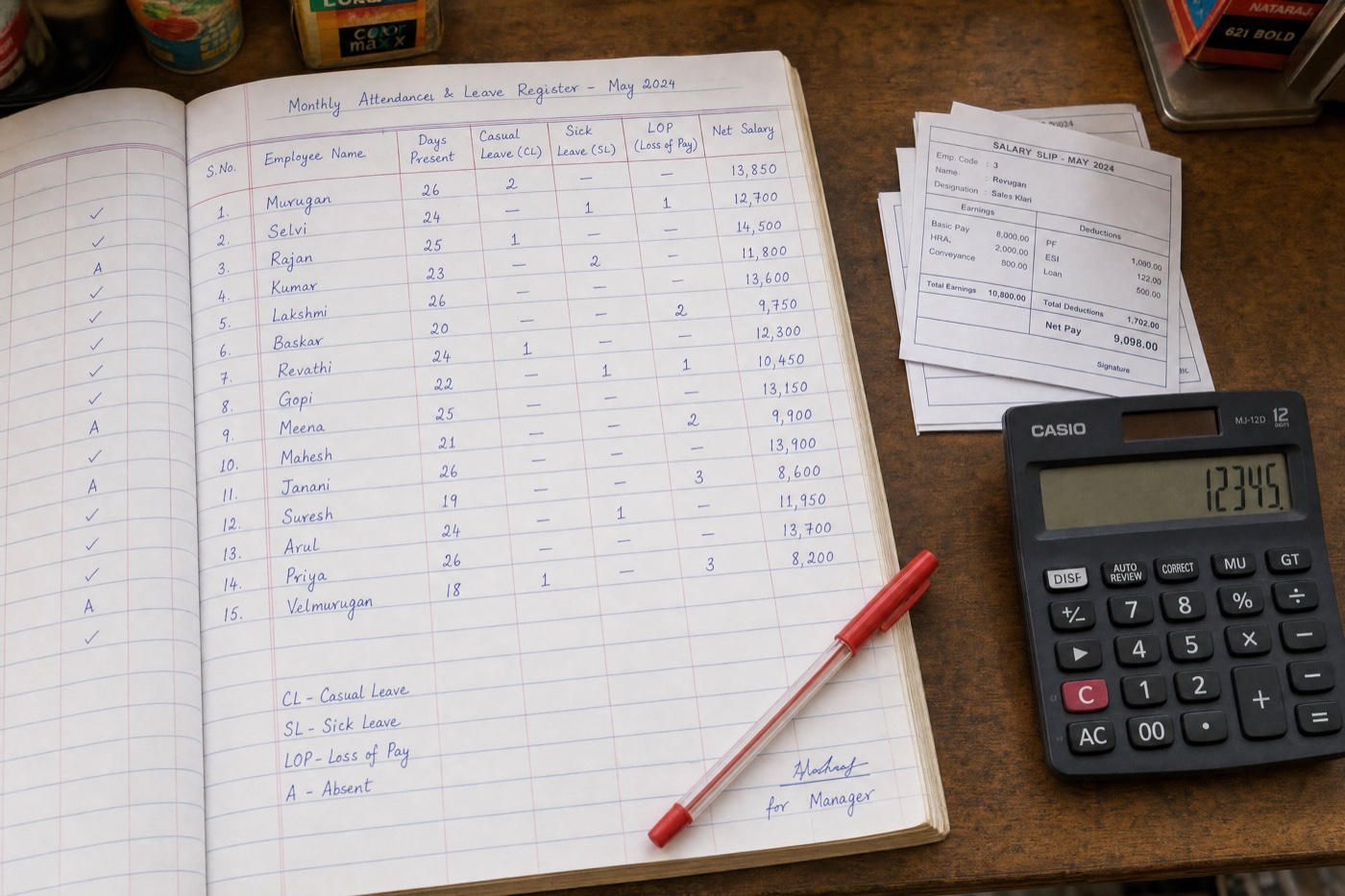
The disputes that come from this are exhausting. "I only took two CLs this year." "No, you took three — once in March, once in June, and once last month." "I don't remember June." And now you are spending twenty minutes arguing about something that should take twenty seconds to look up.
How Rotabook handles leave for shops
Rotabook was built specifically for shops like Rajan's — not for IT companies with HR departments, not for factories with union agreements, but for retail shops where the owner is also the HR manager, the accountant, and the floor supervisor.
When an employee punches in and out on the biometric device, Rotabook tracks their attendance automatically. When they do not punch in, Rotabook marks them absent. At the end of the month, it calculates how many of those absences fall within their entitled leave balance and how many become LOP — and it adjusts the salary slip accordingly.
There is no diary to maintain. No running total to update by hand. No argument about whether that March absence was a CL or an LOP. The record is there, timestamped, from the day they joined.
For shop owners who are just starting to formalise their leave policy, Rotabook's leave management also lets you configure leave balances per employee — how many CLs they are entitled to, how many SLs, whether earned leave accrues monthly or annually. You set it once, and the system handles the rest. It is the same record that feeds payroll at month-end, so the leave you track and the salary you pay never drift apart.
Questions shop owners ask me
Is leave encashment mandatory for shop employees in India?
For earned leave (privilege leave), yes — in most states, leave that the employee has accumulated and not taken must either be carried forward (up to the state-specified limit) or encashed when the employee leaves the job. You cannot simply cancel accumulated earned leave. The specific rules vary by state, so check your state's Shops and Establishments Act for the carry-forward limit.
Do daily wage workers get paid leave?
This depends on how long they have been employed. Under most state acts, an employee needs to have worked for a minimum period — typically 240 days in a year — to be eligible for earned leave. Daily wage workers on short-term engagements may not qualify. However, if a daily wage worker has been with you continuously for more than a year, they likely do qualify for leave entitlements.
Can sick leave be carried forward to the next year?
Generally, no. Sick leave and casual leave are typically use-it-or-lose-it — they lapse at the end of the year if not taken. Only earned leave (privilege leave) can usually be carried forward, subject to the state-specific maximum limit.
What is the difference between LOP and unpaid leave?
They are the same thing, just different names. Loss of Pay (LOP) and Leave Without Pay (LWP) both refer to days when an employee is absent beyond their entitled leave balance. The salary deduction for those days is calculated at the daily rate.
Leave entitlements, carry-forward limits and certificate rules differ from state to state, and the figures in this guide are typical examples, not legal advice. Before you write your shop's leave policy, confirm the exact provisions against your own state's Shops and Establishments Act — or with a local labour consultant.