

A shopkeeper in Tirupur once asked me, half-serious, whether overtime was "a Bombay thing." His staff had worked twelve-hour days straight through the wedding season and the topic of extra pay had never come up. He wasn't being stingy. He genuinely didn't know the rule applied to him. And honestly, the topic of overtime is still sensitive in India that it's considered rude if it didn't come from the shop owner themselves.
Overtime is one of those parts of running a shop that owners assume is more complicated than it is. So they avoid it, or guess, or pay a round-figure "bonus" that has nothing to do with the law. None of those are safe.
So here is the whole thing, plainly.
The rule, in one sentence
If a member of your shop staff works beyond 9 hours in a day or 48 hours in a week, the extra hours must be paid at twice their ordinary wage rate. Not 1.5×. Not a bonus you decide on. Two times.
That "twice the ordinary rate" figure is consistent across the Minimum Wages Act, the state Shops and Establishments Acts, and the newer Code on Wages. Whatever your state, the multiplier does not move. What moves is the threshold — some states draw the daily line at 8 hours, some at 9.
The formula: let's do the actual math
Forget the formula for a second. Lets take a real person.
Latha works at a saree shop in Madurai. Her monthly salary is ₹15,600, all of it basic and dearness allowance. During the Aadi sale her shop ran long, and she put in 18 hours of overtime across the month.
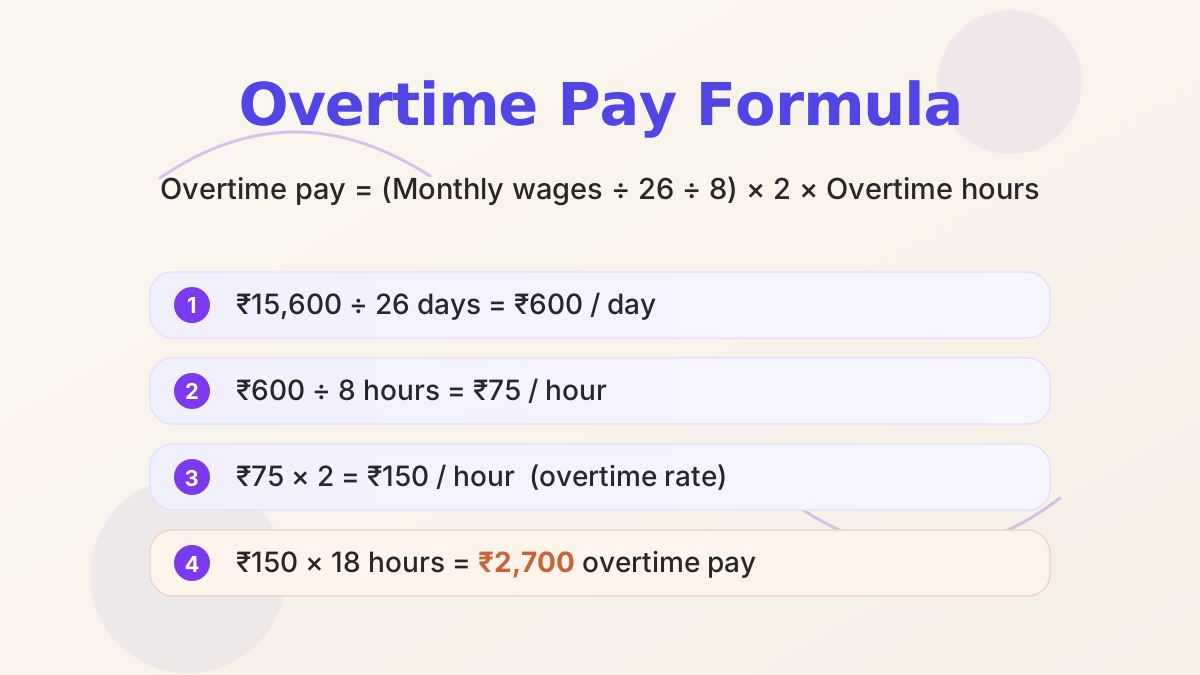
Here is how to calculate her overtime:
- Daily wage: ₹15,600 ÷ 26 working days = ₹600 a day
- Hourly wage: ₹600 ÷ 8 hours = ₹75 an hour
- Overtime rate: ₹75 × 2 = ₹150 an hour
- Overtime earned: 18 hours × ₹150 = ₹2,700
So Latha's pay that month is ₹15,600 + ₹2,700 = ₹18,300, before any deductions — the gross that then flows straight onto her salary slip format.
Written as a formula, it is just this:
Overtime pay = [Monthly wages ÷ 26 (considering one mandatory off a week) ÷ 8] × 2 × Overtime hours
The maths is primary-school stuff. The hard part is not the calculation, it's two questions hiding inside it.
The part nobody fully agrees on: the divisor
Look again at that ₹15,600 ÷ 26. Why 26?
Because the convention, carried over from the Minimum Wages Act, is that a monthly-paid worker's daily wage is the salary divided by 26 — the working days left after weekly offs. Some employers use 30. A few use the actual number of days in that month.
It matters more than it looks. Divide by 30 instead of 26 and Latha's daily wage drops to ₹520, her overtime rate falls to ₹130, and she quietly loses ₹360 that month. Do that across ten staff for a year and you have underpaid by a figure an inspector will happily calculate for you, with interest.
The 8-hours-versus-9 question is the same story. If your state's standard working day is 9 hours, divide the daily wage by 9, not 8. The wrong divisor shifts the hourly rate.
Consistency is what survives an audit, not cleverness.
My advice: use 26 days, and the standard daily hours your state's Shop Act actually specifies. Write it down. Apply it the same way every month. Consistency is what survives an audit not cleverness.
What counts as "wages" here
When the law says "ordinary rate of wages," it does not mean the full CTC on the offer letter.
It means basic pay plus dearness allowance. It leaves out the discretionary bonus, reimbursements, and the overtime itself. You do not calculate overtime on top of overtime.
For a lot of small shops this is academic, because the whole salary is effectively basic with no allowance structure at all. If that is you, your "ordinary rate of wages" is simply the monthly figure you already pay. If you do split salary into components, run the calculation on basic plus DA only.
Where shop owners actually trip up
The mistakes I see are not exotic. They are the same four, over and over.
The most common is paying overtime at single rate — ₹75 instead of ₹150 in Latha's case — usually because the owner thinks of it as "one extra hour's pay" rather than a premium rate. That is half of what is owed.
Close behind is not paying it at all, on the logic that a salaried employee is salaried and that is that. A monthly salary does not switch off overtime. Shop staff are covered whether you pay them weekly, monthly, or in cash.
Then there is the divisor mistake from earlier — quietly using 30. And the fourth: forgetting that work on the weekly off, or a festival holiday, often carries its own premium in many state Acts, separate from daily overtime.
None of these come from bad intent. They come from nobody ever sitting the owner down and explaining the rule. So, please have a seat.
What shifted in 2026
The four labour codes are now in force, and the Code on Wages folds the older overtime provisions into a single national framework. The headline figure, 'twice the ordinary rate' did not change.
What did move is subtler. The new definition of "wages" requires basic-type components to make up at least half of total pay. For shops that used to keep basic artificially low and load the rest into allowances, that reshuffle lifts the base on which overtime is calculated. In plain terms: for some staff, correctly structured pay means overtime is now worth a little more than before. There is also a standard quarterly overtime ceiling of 125 hours, and a 60-hour cap on total weekly hours including overtime.
If your state has notified its own rules under the codes, follow those. The rollout has been staggered.
Keep the register. It isn't optional
Every state Shop and Establishment Act requires an overtime register: who worked extra, when, how many hours, what they were paid. It is the first thing an inspector asks for, and the easiest thing to not have.
This is the unglamorous side of attendance. The part where paper complicates things and where software deals with left hand (literally dominates). Rotabook counts overtime hours against each state's threshold as staff punch in from any biometric device, applies the 2× rate, and keeps the register export-ready. For the wider picture on staff records, I have written the attendance system for small retail shops in India guide.
Questions shop owners ask me
Is overtime double pay mandatory, or can I pay 1.5×?
Double. Twice the ordinary rate is the legal minimum across the Minimum Wages Act, the state Shop Acts, and the Code on Wages. You may pay more. You cannot pay less.
Do salaried shop staff get overtime?
Yes. A monthly salary does not remove the entitlement. If they cross the daily or weekly hour limit, the overtime is owed.
Which divisor do I use — 26 or 30?
26 is the standard convention for turning a monthly salary into a daily wage. Using 30 lowers the hourly rate and underpays your staff.
Does overtime apply on a Sunday or a festival holiday?
Often yes, and sometimes at a separate premium set by your state's Act. Check the specific state rule — this is one place state variation genuinely bites.
What if I don't keep an overtime register?
It is a compliance breach under the Shop and Establishment Act, and it invites a fine plus a re-inspection. Maintain it from day one.
Labour law in India is state-specific, and the codes are still settling into place. This is a general explanation of how to calculate overtime for shop staff in India — not legal advice. For anything you are unsure about, check your state's Shops and Establishments Act or speak to a labour consultant.