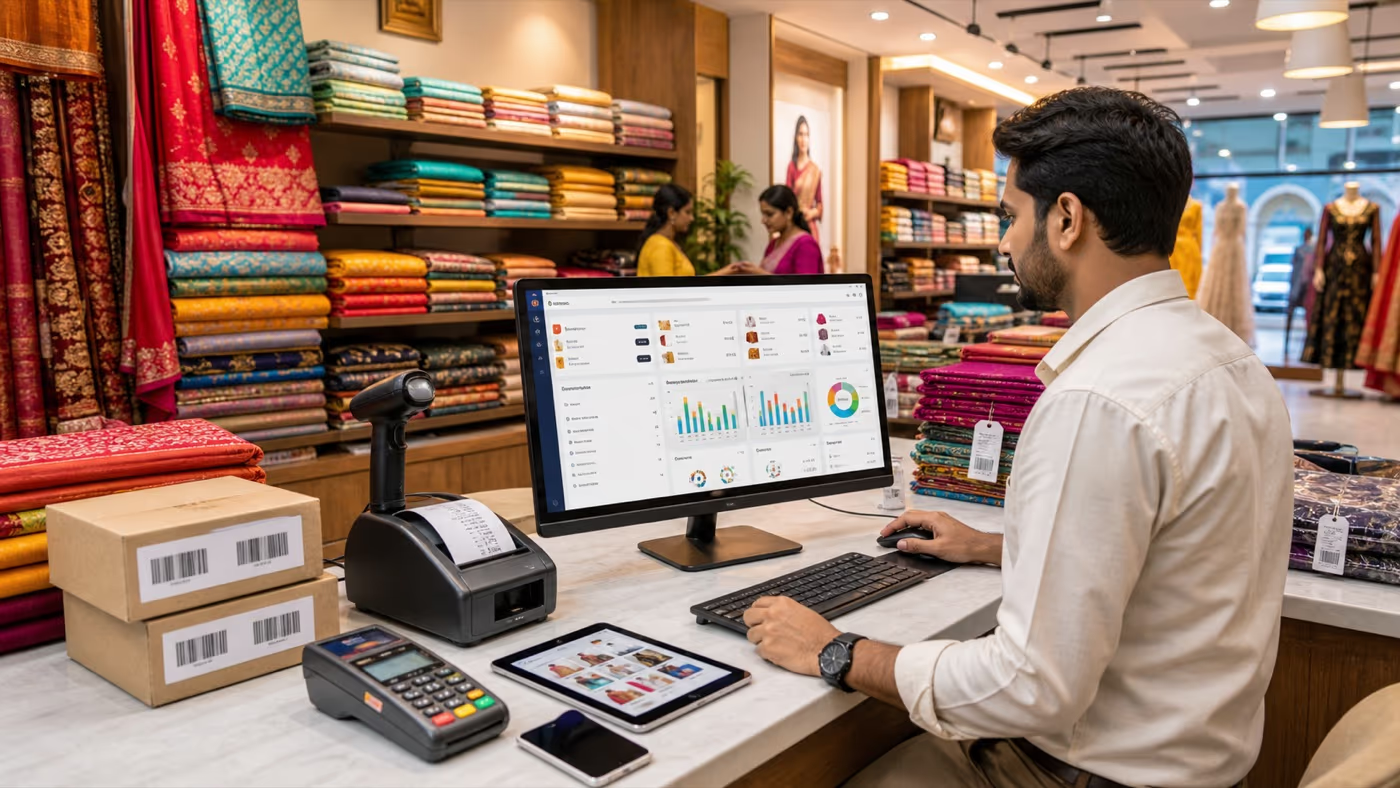

If you run a cloth shop, a saree showroom, or a multi-floor textile retail outlet in India, you've probably been pitched at least four different "textile shop management software" tools by Indiamart leads alone. They all promise the same thing — billing, inventory, GST, "everything in one place." Most deliver one part well and the rest as a checkbox.
I've sat with textile shop owners across Bengaluru, Pune, and Surat. The pattern is clear: there's no single software that runs your shop. There are four very different categories, and you probably need two or three stitched together.
Here's the honest version of what each does, what to look for, and what I'd actually buy.
What textile & garment shop management software actually does
Textile shop management software in India is software that handles the day-to-day operations of a cloth or garment shop — billing customers with correct GST, tracking fabric inventory by colour, pattern, and length, managing supplier credit, generating reports for the owner, and (in some tools) handling staff attendance and payroll. The good ones are mobile-first because most Indian shop owners actually run their business from their phone, not a desk PC.
There's no single software that runs your shop. There are four very different categories.
The thing nobody tells you upfront: no single software does all of this well for a retail textile shop in India. The market splits into four distinct buckets.
The 4 categories of cloth shop billing & inventory software
1. Billing & POS software. Vyapar, Tally, GSTpad, BharatERP, Mybizsoft. This is what you reach for first — generate GST invoices, scan barcodes, accept UPI, print on a 3-inch thermal printer. Strong on billing, weak on staff and deep inventory. Free to ₹3,000/year. Buy this first if all you have today is a manual bill book.
2. Full textile ERP. Marg ERP, SwilERP, SSEL, AdvanceEcom Solutions. Designed for shops that have outgrown billing-only — multi-store, supplier ledgers, fabric production tracking if you run a small mill, salesperson commission, returns and exchanges. ₹500–₹3,000 per month. Overkill for a single 3-staff shop, essential by store #3.
3. Textile-specific inventory tools. VastraApp, Tiya Technology, Vastralaya, Mybizsoft. These specialise in tracking fabric the way a cloth shop actually counts it — by metre, by colour swatch, by design code, by lot number. If your inventory pain is "I don't know which design has 12m left and which has 80cm," start here.
4. Workforce, attendance, and payroll. This is where Rotabook lives. None of the three above handle staff attendance, shift rosters, biometric integration, or salary calculation properly. They'll add a thin "attendance" tab as an afterthought. If you have 5+ staff across one or more outlets, you need a real workforce tool — not an afterthought tab.
| Software category | Best for | Top tools in India | Monthly cost | Staff attendance? |
|---|---|---|---|---|
| Billing & POS | Single shops, basic GST | Vyapar, Tally, GSTpad | Free–₹300 | No |
| Full textile ERP | Multi-store, wholesale | Marg ERP, SwilERP | ₹500–₹3,000 | Basic only |
| Inventory specialists | Deep fabric tracking | VastraApp, Tiya | ₹300–₹1,500 | No |
| Workforce & payroll | Small and mid-size shops (under 500 staff) | Rotabook | ₹49/employee | Yes (full biometric) |
For most Indian textile shops with 3–50 staff and 1–8 outlets, you'll end up running a billing tool + an inventory tool + a workforce tool, not one monolithic platform. Be smart with your selection — you don't need 5 different tools.
6 features every saree & textile retail software must have
Most "shop management software" lists ignore the parts that make textile shops different. Here's what actually moves the needle:
- Fabric variant tracking. Same design, different colour, different length, different lot number. Your software has to model SKUs as design × colour × pattern × length, not flat product codes.
- Credit ledger by customer. Tailors and regulars buy on running tabs. The software has to track customer-wise dues with WhatsApp reminders built in.
- Multi-store stock sync. Move 5m of a design from your Surat branch to your Pune branch — the software should reflect both balances in seconds, not at end-of-day.
- GST 5% / 12% / 18% handling. Saree, fabric, ready-made garment — different rates per the CBIC GST schedule, sometimes on the same bill.
- Salesperson-wise sales tracking. Commission structures are common; the software needs to attribute every bill to a salesperson.
- Cutting and packing notes. "2.4m for blouse, 0.6m for fall" — printable on the bill so the cutter doesn't have to ask.
If a vendor's demo skips even one of these, the software wasn't built for textile retail.
The staff attendance & payroll gap most software ignores
Every textile owner I've sat with has the same end-of-month story. Their billing software is fine, their inventory software is fine, but staff attendance is on a paper register, salary is calculated in Excel, and biometric machine data gets exported to a USB drive once a month. By the 5th, the accountant has spent two days reconciling.
This is why I built Rotabook. The same problem I wrote about for general retail in my guide on attendance system for small retail shops in India shows up sharper in textile because shifts are longer (showrooms open 11 to 9), staff turnover during festival season is brutal, and Shop & Establishment Act compliance lands hardest on visible high-street stores. Textile retail has the same staff-management gap as kirana and salon — but the rupee impact is bigger because the headcount is bigger.
The hidden cost of manual attendance during festival season
Talk to any textile owner the week after Diwali and you'll hear the same thing — October payroll was a mess. That's where the cost of manual attendance actually lives. Not in the quiet months. In the months that matter most.
Take a mid-size showroom with 15 employees on the floor through the festival rush. Doors open 10am to 11pm for three weeks. Two helpers brought in temporarily. Three salespeople on overtime almost every day. The biometric device at the entrance captures every punch — but the data lives on the device until someone exports it to a USB drive on the 1st. The shift roster is in a WhatsApp group. Overtime gets calculated by the accountant on the 3rd of November from photos of a paper register.
Three things go wrong every single year:
- Buddy punching during peak rush. Staff covering for a colleague who's running late — worth a conservative ₹400 per missed half-hour in a busy showroom. Across 15 people over three weeks: ₹12,000–₹18,000 of paid-but-not-worked time.
- Overtime calculation errors. A paper-based accountant miscalculates the 2× rate on roughly one in five overtime claims — either missing the rule entirely or computing on basic instead of gross. On a 15-staff shop with festival overtime, that's another ₹6,000–₹10,000 either underpaid (and staff resent it for months) or overpaid (and you absorb it silently).
- Unrecorded late arrivals. Without an automated cut-off, the 11:18 punch quietly becomes "in by 11", every day. Across the season, that's the silent ₹15,000 problem nobody catches.
Festival season alone — one shop, one month — typically bleeds ₹35,000–₹45,000 to manual attendance. That's not theoretical. It's what every textile owner I've sat with has confirmed when we walked through their last payroll register together. A workforce tool with a real biometric integration pays for itself before Diwali ends.
A 7-question buying checklist for textile shop software
- Does it handle fabric variants (colour × pattern × length × lot)?
- Does it support multi-store stock sync in real time?
- Does it auto-apply the right GST rate for textile vs. ready-made?
- Does it integrate with biometric machines you already own (ZKTeco K40, eSSL MB160) for staff attendance?
- Does it generate Shop & Establishment Act–compliant attendance and wage registers?
- Is it under ₹500 per month below 25 employees / one outlet?
- Can your shop manager set it up without a vendor visit?
If 1, 4, or 5 is "no", you're looking at the wrong tool.
What textile shop management software costs in 2026
Billing-only tools: free (Vyapar Android) to ₹3,000/year. Full textile ERPs: ₹500–₹3,000 per month per outlet. Inventory specialists: ₹300–₹1,500 per month. Workforce + payroll tools: ₹49–₹149 per employee per month. Biometric hardware: one-time ₹4,000–₹18,000.
Total monthly cost for a 10-staff, 2-outlet textile retail business typically lands at ₹2,500–₹6,000 — recovered in payroll-error reduction within 60 days.
How to transition from paper to software in 30 days
The biggest reason owners stay on paper isn't cost. It's the fear of a botched transition during business hours. Here's the 30-day path that actually works for a traditional cloth shop, broken down week by week.
Week 1 — run paper and software in parallel. Pick one billing tool and one workforce tool. Set them up on the counter PC. Every bill written in the bill book also gets entered into the software at end-of-day by the manager. Don't print software invoices to customers yet. The goal is to surface every edge case — credit notes, partial returns, mixed-GST bills — without risking a single live transaction.
Week 2 — software invoices on weekdays, paper on weekends. Switch to printing thermal invoices Monday to Friday, when foot traffic is lower and the manager has time to debug. Keep the bill book ready for the Saturday-Sunday rush, when a software hiccup could cost a sale. By Friday, most owners notice the software is faster than the bill book — that's when conviction builds.
Week 3 — train the accountant on month-end reports. Have them pull the GSTR-1 summary, the sales-by-salesperson report, and the stock movement register from the software. Compare line by line against their manual books. The goal is for them to trust the digital output before the actual month-end falls due.
Week 4 — enrol staff on the biometric device and start digital attendance. Walk every employee through the enrolment, then run the first payroll cycle entirely from the software. Keep the paper attendance register as a backup for one more month, then retire it. If the device isn't talking to your PC yet, my guide on how to connect a biometric device to your computer covers the cable, IP, and subnet setup.
Total elapsed time: 30 days. Total downtime: zero. Total cost of the transition itself: a few evenings of the manager's time and one Sunday afternoon for the accountant. The hardest part isn't the software — it's the manager's willingness to enter every bill twice for one week. Past that week, it runs itself.
Where Rotabook fits
Rotabook handles the workforce side: staff rota, biometric attendance with native ZKTeco K40 and eSSL integration, Shop Act–ready registers, one-click payroll. It plugs alongside whatever billing or inventory tool you already use. Set-up takes 15 minutes. Built for 3–50 staff across multiple outlets.
Frequently asked questions
What is the best textile shop management software in India?
There isn't one. The right answer is a stack: a billing tool (Vyapar or Tally for under-2-store shops, Marg for larger), a textile-specific inventory tool (VastraApp or Tiya), and a workforce tool (Rotabook for staff, attendance, and payroll).
Can one software handle billing, inventory, and staff for a textile shop?
In theory, full ERPs like Marg or SSEL claim to. In practice, their staff-management modules are weak. Most owners I've spoken to run a dedicated workforce tool alongside their ERP.
How much does textile shop management software cost in India?
Billing tools start free (Vyapar). Full textile ERPs run ₹500–₹3,000 per month per outlet. Workforce + payroll adds ₹49–₹149 per employee per month. Total for a 10-staff, 2-outlet shop is typically ₹2,500–₹6,000 per month.
Is GST handling automatic in textile shop software?
Most leading tools (Tally, Vyapar, Marg, VastraApp) auto-apply the correct GST rate based on HSN code. Always verify on a test invoice — saree at 5%, ready-made garment under ₹1,000 at 5%, over ₹1,000 at 12%.
Does textile shop software work offline?
Vyapar's Android app runs fully offline and syncs when online. Most cloud ERPs (Marg, SwilERP) need an internet connection to function.
Is there any free garment shop billing software in India?
Yes — basic tools like Vyapar offer a free Android version for simple GST invoicing. The catch: free tiers don't handle fabric variant tracking (design × colour × length) or staff attendance. Most shops outgrow the free tier by the second outlet or fifth employee.
Which software is best for a saree showroom?
A saree showroom needs three things billing-only tools don't give you: barcode scanning for unique pieces, multi-store stock sync, and salesperson commission tracking. You'll typically run a dedicated inventory tool (VastraApp or Tiya) for stock, a billing tool (Vyapar or Tally) for invoices, and a workforce tool (Rotabook) for attendance and payroll.