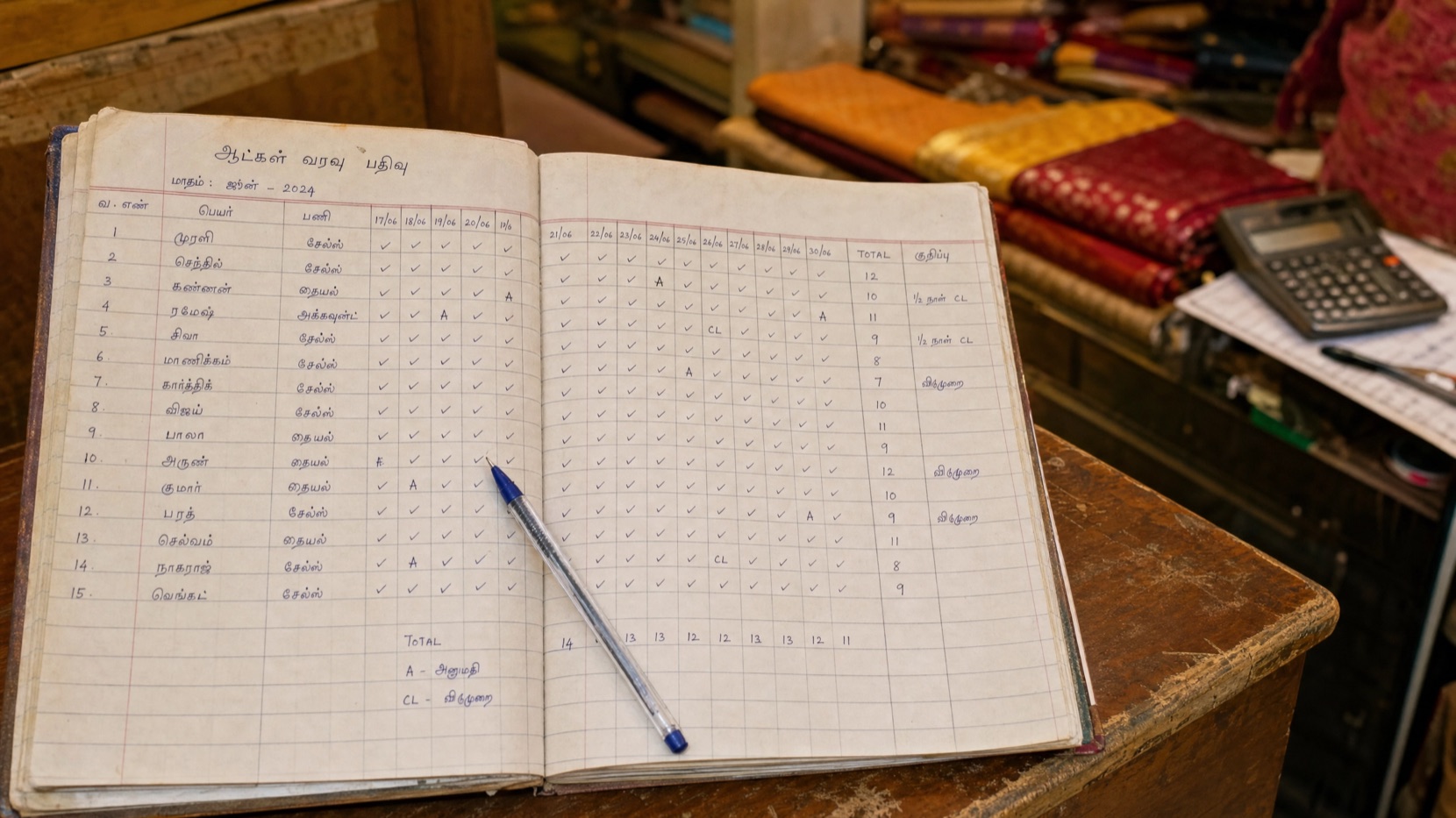

I have a friend in Salem who runs a textile shop his grandfather opened more than sixty years ago. Third generation, same family, same trade. On one visit he walked me to a room behind the shop, a kind of godown, dark and a little musty. Along every wall stood steel almirahs, and each one was packed with diaries. Sixty years of them.
He pulled one out almost at random. 1991. He turned to August, to one ordinary day, and there it was in someone's careful hand: that day's attendance for every worker, the expenses, the sales, the whole day accounted for on a single page. I stood there astonished at how completely a textile shop used to document its own life, decades before anyone in the trade said the word "software."
Here is the part that stayed with me. Not much has changed. Walk into plenty of textile shops today and you will still find the good old diary or register doing the same job, logging who turned up, what was spent, what was sold.
For a long time that was enough. The trouble is that the ground under those diaries has shifted, and the day it matters most is the day a labour inspector walks in and asks for your attendance record. The state of that register decides how the rest of the visit goes.
If you're reading this, you're probably somewhere on that same worry. Maybe your paper register is half-filled. Maybe you grabbed a free template off some American website and you're quietly wondering whether it would survive an inspection. Maybe you just hired your third employee and thought, "I should be writing this down properly."
You should. Below is a format that actually fits Indian shops. Free, no email wall, yours to keep. The rest of this post is everything those sixty years of diaries got right, plus the few things the law now expects you to add.
A staff attendance register for an Indian shop should record each employee's name, ID and designation; their daily in-time, out-time and a status code (Present, Absent, Weekly Off, National Holiday); total hours and overtime; and a signature column, in a format that satisfies your state's Shops and Establishments Act. You can keep it on paper, but it must be complete, signed, up to date, and retained for at least three years — and up to five as the new labour codes roll out.
A staff attendance register format built for Indian retail — the Shop Act columns and the status-code key already in place, in editable Excel and a print-ready PDF. No sign-up, no email. Jump to the download ↓
Why generic attendance sheets fail Indian shop owners
Let me save you a search. The template ranking at the top of Google for "attendance sheet" is almost certainly built for an office in Ohio.
It will have tidy columns for clock-in and clock-out. It will not have a column for Weekly Off, because the American work week doesn't carry the same legal weight ours does. It won't know what a National Holiday entry should look like. And it definitely won't mention the words "muster roll," which is exactly the omission that gets shop owners into trouble.
Here is the distinction nobody explains. An attendance register, loosely, is any record of who turned up. A muster roll is the legally recognised version of that record: the one named in labour law, the one an inspector is actually entitled to demand. In several states the official document is literally titled the "muster roll cum wage register." Maharashtra has Form II. Tamil Nadu, Karnataka and the rest each have their own. The point is that a muster roll is a muster roll because the law defines what it must contain, not because you typed that label at the top of a spreadsheet.
So when you download a generic sheet, you get the shape of attendance with none of the legal substance.
It looks like compliance. Under inspection, it isn't.
And this matters more in 2026 than it did even a year ago, because the ground is shifting under everyone. India's four labour codes, which consolidate twenty-nine older laws, are now rolling out, with much of the detail still working its way through central and state rules as I write this. A common thread already runs through them: registers are expected to move to electronic formats, and retention is moving toward five years from the last entry. None of this means anyone will fine you tomorrow for keeping paper. But the direction is not subtle. The era of the cloth-bound book under the counter is ending, and it is ending on a government timeline now, not just a convenience one.
Mandatory columns under the Shops and Establishments Act
Every state runs its own Shops and Establishments Act, so the exact form number changes the moment you cross a border. But the bones are the same everywhere, because they all answer the same question an inspector is asking: can you prove who worked, when, for how long, and that you paid them correctly for it?
A compliant Shops and Establishments Act attendance register, at minimum, needs:
- Employee name and a unique ID or serial number. So two Sureshes never get confused for one.
- Designation. Cashier, salesman, tailor, helper — retail roles, which the generic templates flatten into a single word, "employee."
- Date, with daily In-Time and Out-Time. The actual hours, not just a tick.
- Total hours worked for the day.
- Overtime hours, tracked separately. Overtime is paid at twice the ordinary rate under most state Shop Acts, so it cannot sit hidden inside the normal hours.
- A daily status code: Present, Absent, Weekly Off, National Holiday, Leave.
- A signature or thumb-impression column. Inspectors look for this specifically. A register with no signatures reads, to them, like a register you filled in this morning.
The status codes are worth standardising, because consistency is what makes the book legible to someone who isn't you:
| Code | Meaning |
|---|---|
| P | Present |
| A | Absent |
| WO | Weekly Off |
| NH | National Holiday |
| L | Leave (paid) |
| H | Half day |
Print the key at the top of the register and never invent a new letter halfway through the month. The single most common mess I see in real shop registers is three different people running three different shorthand systems in the same book.
It helps to know what the inspector actually does with these columns, because it tells you why each one is there. They ask for the muster roll, then they cross-check it against your wage slips: do the hours recorded match the wages paid? They look for weekly rest days showing up consistently. They check whether overtime entries line up with overtime payments. They look for signatures. A register that can't survive that cross-check is where penalties start, and depending on your state and the offence those run from a few hundred rupees into the tens of thousands.
One last thing the generic sheets miss: retail doesn't run nine-to-five. You have split shifts, the fellow who opens at nine and the fellow who closes at nine, festival weeks where everyone pulls fourteen-hour days, and a weekly off that lands on a Tuesday because Sunday is your best sales day. Your register has to have room for all of it. The one below does.
Download your free staff attendance register format (Excel & PDF)
Here it is. I built this for the shops I actually know, which means it carries the Shop Act columns, the status-code key already printed at the top, daily columns for a full 1–31 month, and summary columns at the end that add up Total Days Present, Total Overtime Hours and Total Leaves — so you're not doing the maths by hand on the 30th.
Download the Excel register (.xlsx) Download the print-ready PDF
Free, no email required. The Excel version totals Days Present, Overtime and Leaves for you with built-in formulas; the PDF is for shops that still prefer pen on paper.
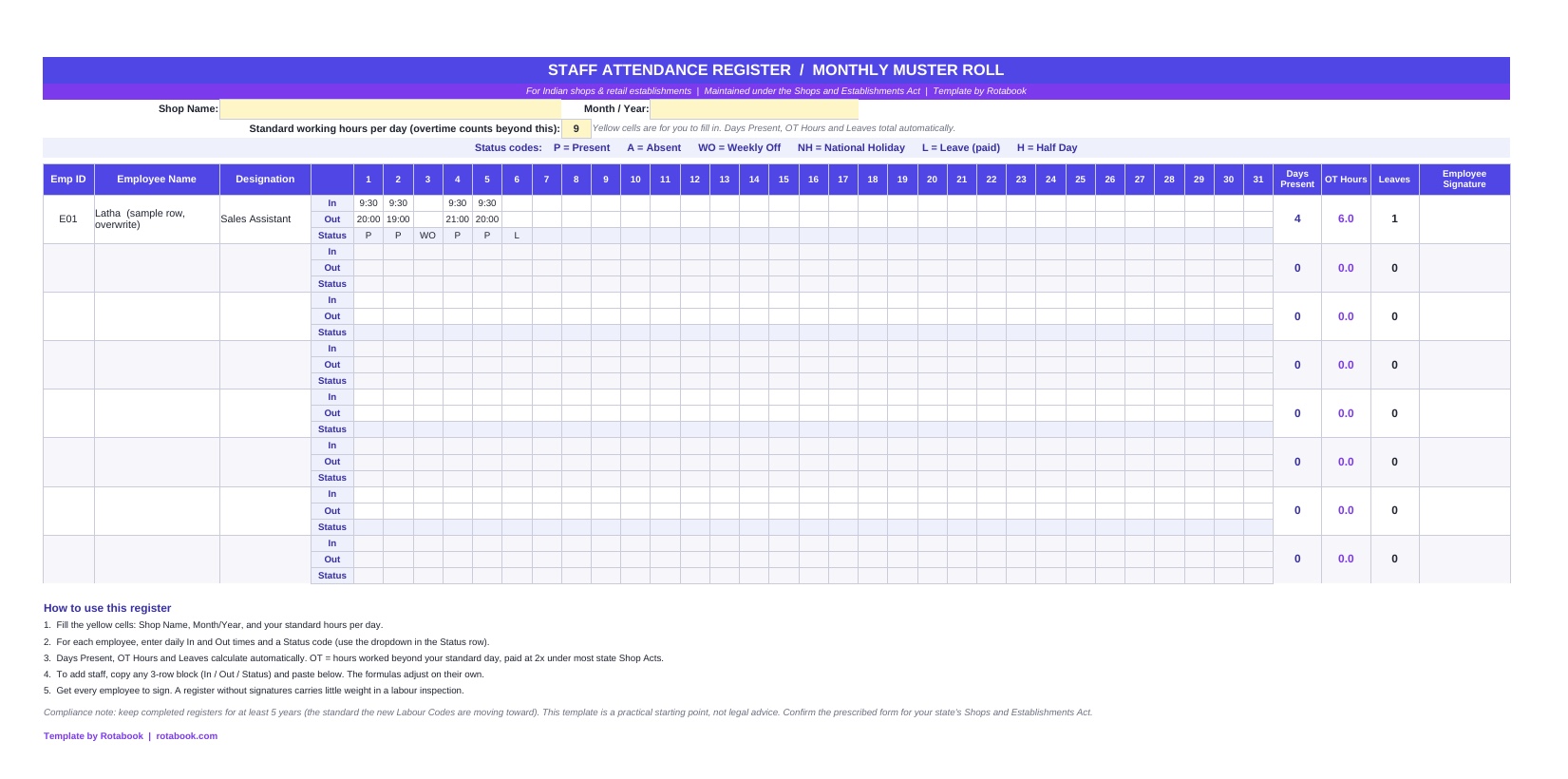
What you're getting, specifically:
- A header block for Shop Name and Month / Year, because a register page with no month on it is useless six months later.
- Employee ID, Name and Designation down the left.
- Daily columns for 1 to 31, each with room for In, Out and a status code.
- Summary columns that total Days Present, Overtime Hours and Leaves Taken automatically.
- A signature column for every employee.
It's the same attendance register format in Excel that I'd hand a relative opening their first shop. Free to download, free to edit, and there's no form demanding your email first — because gating a template behind a sign-up is the kind of thing that makes me close the tab too.
The hidden cost of manual attendance registers
Now the part I owe you honestly, because I have real affection for those diaries in Salem: a paper register is fine right up until the moment it isn't, and the moment it isn't tends to be expensive.
Three places it quietly costs you.
The first is month-end overtime maths. Every owner I know who runs a paper register does the same thing on the last day of the month: sits down with a calculator, the register and a cup of tea, and loses an evening turning ticks into rupees. It's slow, and slow work done tired is work done wrong. One mis-added overtime row and you've either underpaid someone who'll quietly resent it, or overpaid someone you'll never claw it back from. (If overtime is where your evenings go, I wrote a whole piece on calculating overtime for shop staff that walks through the formula properly.)
The second is buddy punching. That's the polite name for the salesman who signs the register for the friend running twenty minutes late, every day, for a year. A paper book has no way of telling a real arrival apart from a favour between colleagues. You pay for hours nobody worked, and you can't even see it happening.
The third is the book itself. Paper floods. Paper tears. Paper gets grabbed to wrap a customer's purchase in a hurry, and yes, I have watched that happen. A register is the one document you're legally required to produce on demand, and it's sitting under a counter in a monsoon-prone shop with a working life measured in tea-stains. Lose three years of it to water damage and there is no backup version to reach for.
None of this makes paper evil. It makes paper fragile. And the law is now nudging everyone toward something sturdier.
How Rotabook automates attendance for Indian shops
Fair warning: this is the part where I tell you about the thing I build. I'll keep it honest.
Rotabook is attendance and payroll software for small Indian shops — the three-to-fifty-staff kind — built around the compliance you've just read about rather than bolted onto it afterwards. It runs on-premises, on the shop's own computer, which matters more than it sounds: there is no per-employee monthly cloud subscription, just one flat price, so your software bill does not climb every time you take on staff. The reason it exists is more or less this blog post. I got tired of watching good shopkeepers lose money and sleep to a paper book.
Instead of a register under the counter, staff clock in on a biometric device wired to that computer over your shop's network. It works with the machines you probably already own or can buy cheaply — the ZKTeco and eSSL biometric devices that are standard across Indian retail — pushing punches straight into the software with no manual entry. (Already have a device and want to wire it up yourself? Here's how to connect a biometric device to your computer.)
From there the boring, valuable part happens on its own. The system keeps a proper digital attendance record, generates a Shop Act compliant muster roll you can hand an inspector, calculates overtime at the correct rate, and rolls the whole month into payroll without you and a calculator losing an evening. Buddy punching goes away, because a fingerprint can't cover for a friend. The records can't flood, because they aren't paper. And the five-year retention the new codes ask for is simply there, automatically.
You don't have to make the leap today. Download the template, keep your book, get compliant the manual way first. But if you felt any of the pain in the section above, you now know there's a version of all this that doesn't cost you your month-end.
Questions shop owners ask me
Is a digital attendance register legally valid in India?
Yes. Electronic records have had legal standing since the Information Technology Act, 2000, and the new labour codes now rolling out expect registers to be maintained electronically. Indian courts have also upheld biometric attendance at work, a 2025 Supreme Court ruling being the most cited. One caveat worth knowing: if you collect biometric data, the Digital Personal Data Protection Act, 2023 treats fingerprints as sensitive information, so you need your staff's informed consent to gather it. So a digital register isn't merely allowed — for a growing number of establishments it's now the format the law prefers.
What is the difference between a muster roll and an attendance register?
An attendance register, broadly, is any record of who was present. A muster roll is the legally defined version: the statutory register named in labour law and in your state's Shops and Establishments Act, with prescribed columns an inspector is entitled to examine. In many states the official document combines both as a "muster roll cum wage register." Put simply, every muster roll is an attendance register, but a casual attendance sheet is not automatically a compliant muster roll. The template above is built to muster-roll standard.
How long must a shop owner keep old attendance records?
Under most state Shops and Establishments rules, the long-standing requirement has been to keep records for at least three years from the last entry. The new labour codes move this toward five years from the last entry. So the safe answer in 2026 is to keep your attendance and wage records for five years. This is, incidentally, far easier digitally, where five years of records take up no shelf space and survive a flood.
This is a guide written from experience, not legal advice. Shop and Establishment rules genuinely differ from state to state, and the labour-code rules are still being notified as I write this in mid-2026. Use the template, use the explanation, and for anything that turns on a specific number or penalty in your state, check with your local labour office or a consultant. The cost of asking is an afternoon; the cost of guessing wrong is exactly the kind of thing those careful diaries were always trying to keep at bay.